Showing posts with label low carbohydrate. Show all posts

Tuesday, July 24, 2012

Spiced, Baked Catfish with Simple Zucchini

Sometimes during the summer, when it's hot outside and my air conditioner is acting up and I just don't feel like eating a whole lot, I just want a really simple, light dish that doesn't take too much fuss to throw together and clean up.  Today's is one of those meals.

Ingredients:

2 catfish fillets (mine were "basa" fillets and they are HUGE)
Spices, to your taste:  paprika, thyme, salt, pepper, lemon, garlic, and parsley.  I used about 1/2 teaspoon of each.
Juice of 1 lemon
1 T. olive oil

2 medium zucchini, thinly sliced
1 small red onion, thinly sliced
1/2 t. dried thyme
1/2 t. lemon-garlic seasoning (I used Penzey's)
Salt & pepper to taste

Instructions:

Preheat your oven to 350F.  Use the oil to prepare 2 pans, one for the zucchini, and one for the fish.

Sprinkle both sides of the fish with the spices and herbs and place in the pan.  Squeeze lemon juice over them.

Stir together zucchini, onion, and spices.  Place in prepared pan.

Bake for 15-20 minutes, until the fish flakes easily and the zucchini is cooked through (mine was a little undercooked, but I like it like that).


Serve hot, with tartar sauce if you desire.

Saturday, January 7, 2012

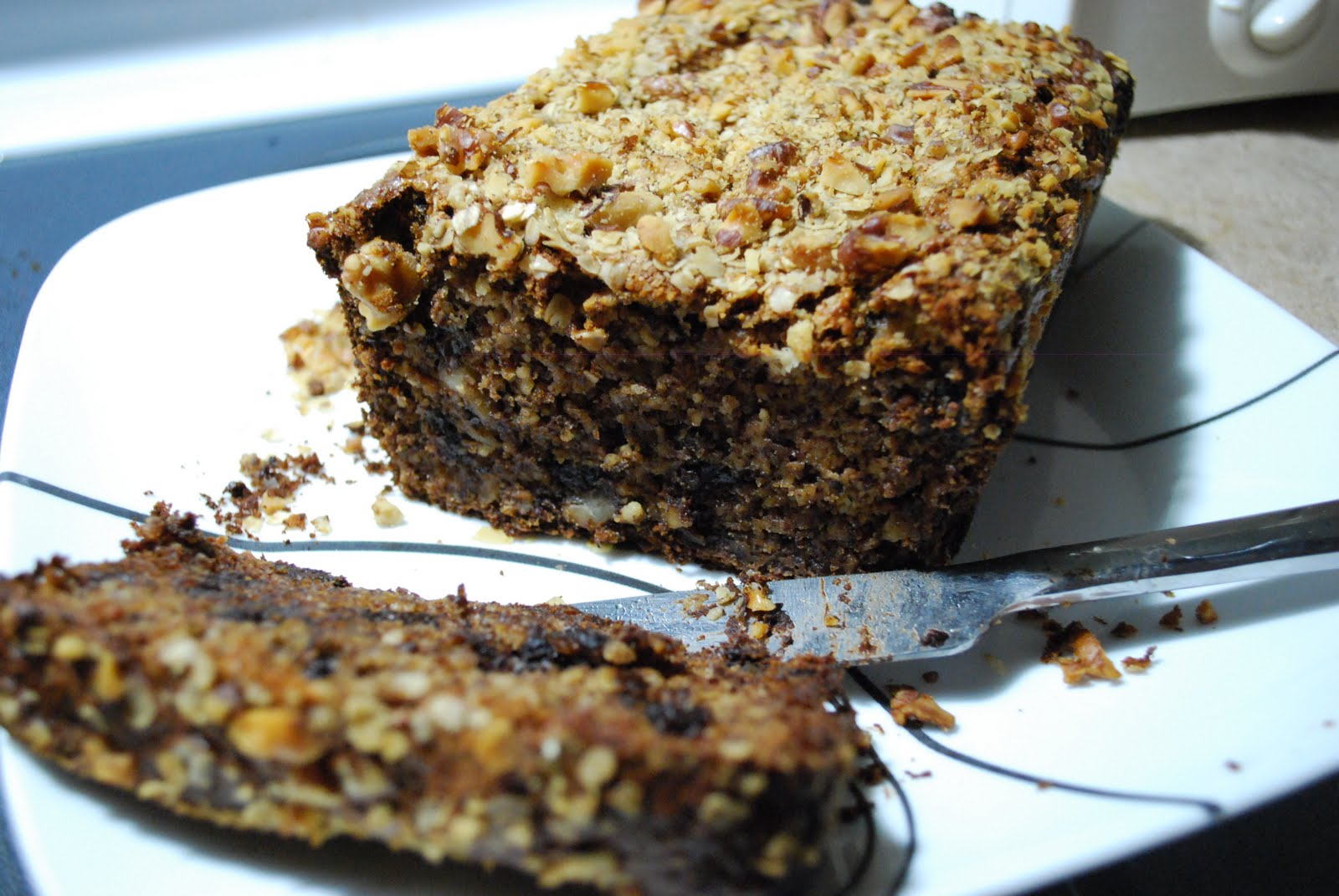
Low(er) Carb Chocolate Chip Banana Bread with Walnuts (and How to Make Your Own Almond Flour)

I love banana bread. It has been a staple in my house since I was a small, small child and I hate going without it. I also have a big sweet tooth when it comes to cookies and cake (banana bread falls under cake in my mind). When we went low-carb, I thought, "How? How will I get my precious banana bread? How will I have my delicious desserts?"

Then I discovered almond flour through this lovely website. But, alas, I wanted to use my banana bread recipe that everyone raved about. So what did I do?

Through trial and error (so many errors), I finally have a low(er) carb banana bread that I can rave about. And I am sharing it with you.

Ingredients:

2 cups almond flour
¼ cup ground flax seed
¼ cup all-purpose flour
1 t. baking soda
1 t. baking powder
½ t. salt
1 t. ground cinnamon
1 cup Splenda (or substitute sugar of your choice—just make sure it’s equal to 1 cup sugar)
½ cup cooking oil
2 large eggs
¼ cup Greek yogurt
1 t. vanilla extract
3 overripe bananas, mashed
½ cup walnuts, chopped
1 cup semi-sweet chocolate chips (optional, but delicious)
1/3 cup walnuts, chopped
A small handful of rolled oats

Instructions:

Preheat oven to 350 degrees F (approx. 175 degrees C). Butter and flour a bread loaf pan.

Combine almond flour, flax seed, all-purpose flour, baking soda, baking powder, salt, and cinnamon in a small bowl. Set aside.


Using a hand mixer, combine the oil, Splenda, and 2 eggs in a large bowl until the mixture is pale and frothy. Add ½ of the dry ingredient mixture to the bowl, mixing well. Add the Greek yogurt and vanilla extract. Mix well. Add the rest of the dry mixture, and mix again. Your batter will probably be quite thick.

Mix in the mashed bananas.


Stir in ½ cup chopped walnuts and chocolate chips.


Pour batter into the prepared loaf pan. Top with remaining 1/3 cup of chopped walnuts and handful of oats. Lightly press the topping into the batter (this will prevent it from not sticking).

Bake in the preheated oven for 1 hr. to 1 hr. 15 minutes, or whenever a toothpick inserted in the center comes out clean.


Notes:

You CAN make this gluten free (and lower carb) by using entirely almond flour, but be aware that it will not be as fluffy as using the ¼ cup of flour. It tastes perfectly fine, but it falls a bit flat and has a more moist texture. This is my final recipe after much trial and error, and the yogurt seems to help the bread hold a more cake-y texture (before, I tried using milk, buttermilk, etc).

If you want to go even lower in carbs, I suggest using the darkest chocolate chips you can find (or eliminating them completely) and substituting more walnuts (they help hold the bread’s structure).

Almond Flour

Now, almond flour is often readily available at your local supermarket (I often find it in the gluten free section) or your local health food shop. Unfortunately, it's very expensive for a small amount of flour--where I live, it's about $12 for approx. 3 cups of almond flour. I can easily go out and buy a 2 pound bag of almonds for $20 and have far more almond flour for my disposal.

What you'll need:

A food processor
Almonds (whether raw or blanched is your preference)
Patience

Place the almonds in batches into the food processor. Mine is tiny, so I do my almond flour about 1/2 cup at a time.

I first use the "Chop" setting and pulse it until the almonds are entirely chopped. Then I grind.

Pulse the almonds until you start to see a layer of almond meal building up at the bottom of the processor like this:

That's almost almond butter! This tells you that the flour is getting very finely ground.

Stir it up (I use a whisk or a fork), put into a container and save it for your baking. Ta-daaa, almond flour!

If you want to get REALLY technical about it and get your almond flour down to a flour consistency, you can sift your almond flour and grind down the larger pieces even more. I have even done this in a mortar and pestle. Does it make for a more flour-like consistency? Absolutely. Is it worth the time? Not in my opinion. If you're trying to impress guests or hide the fact that it's not normal flour, maybe. I find for everything else, having some more mealy type pieces doesn't bother me at all.

Friday, January 6, 2012

Ground Pork Stew with Greens & Beans!

I love making soups in huge batches, as I then have something light and simple for lunches for the rest of the week (usually). Since we've all put on some pounds over the holidays (which is fine, it's winter!), I feel like soups are the best way to trim your waistline and get your health back in order without sacrificing taste.

This recipe was adapted from this Kalyn's Kitchen recipe, which is where I get a majority of my low-carb recipes. I apologize, no pictures of the making process, as I started this blog after I had it all ready to go in the slow cooker.

P.S. A Crock Pot is one of your best friends.


Ingredients:

1 T. olive oil
1 lb. lean ground pork or beef (I used pork, because that was what I had)
2 stalks of celery, diced
1 medium onion, diced
3 cloves of garlic, minced
1 can red kidney beans, rinsed
1 lb. diced tomatoes (you could also use canned tomatoes, but I had fresh ones in my fridge)
1 cup of tomato sauce (if you use canned tomatoes in juice, I think you can skip this)
1 T. dried thyme
1 t. cayenne pepper (I like it spicy--use less if you don't)
4 cups of homemade beef stock (or 2 cans of beef stock and some water)
2 cups of water
Salt and ground pepper to taste
2 cups cabbage (I used savoy), thinly sliced and chopped
1 cup spinach, chopped
3 T. white wine vinegar (or more if, like me, you like the flavor)
Sour cream and/or cheese of choice (I used feta) to garnish

Instructions:

Heat the olive oil over medium-high heat in a pan. Add ground meat and brown.

Place onion, celery, garlic, beans, tomatoes, tomato sauce, thyme, cayenne, beef stock, water, and browned meat into your slow cooker and cook on high for 4-6 hours, or low (if you're going to be out all day) for 8-10 hours. It's that easy!

About an hour before serving, taste the soup and season with salt and ground pepper, and anything else you might want to throw in. Add the chopped cabbage and spinach, and allow to cook for another hour. Before serving, stir in vinegar.

Garnish with sour cream and/or cheese (or not) and enjoy! It's really that easy!

Update: Just an FYI, the amount of water you add can be adjusted according to how liquid-y you like your soups. If you like them REALLY chunky and more like a stew, reduce the water.

Also, if you're a Sriracha nut like me, I think it'd taste really good in this.

Thursday, January 5, 2012

So What's This All About?

For the last year, my husband and I have been following a low-carb/low glycemic index lifestyle in order to better ourselves and be healthier. For those of you reading who are just starting out with this, a few definitions for you.

What is low-carb?

Low-carb, or low-carbohydrate, means that one restricts any form of sugar, starch, or other digestible carbohydrate from one's diet. Some low-carb diets prescribe an amount of carbohydrates allowed per day (20g-50g) while others suggest only having one carbohydrate serving per day, or a few a week. Certain carbohydrates cause an insulin spike in the blood stream, which is thought to cause the body to create fat, and the body's cells no longer feed off of bodily fat, but the sugars in the blood stream, leading to weight gain. One can easily adjust how many carbs to eat based on lifestyle activities (exercise, calorie intake, etc). Interested in reading more? Wikipedia has a large article about it.

What is low glycemic index?

The glycemic index describes how quickly carbohydrates are broken down in the body to form glucose. Refined ("bad") carbs (white flour, sugar, corn) tend to break down much faster in your system, causing the aforementioned insulin spikes. "Good" carbs, such as fruits, vegetables, or whole grains break down much slower and enter your system more slowly, not causing any spike in insulin, and therefore not causing weight gain. The South Beach diet is a low glycemic index diet. Want to read more? Another Wikipedia page for you!

Now, is this for you? Maybe not. Perhaps you just want some healthier eating options? Some advice to better your eating habits? Then this can still be a resource for you!

Personally, we eat minimal carbohydrates during lunch and dinner, with fruits and vegetables allowed as long as they are lower on the glycemic index. Breakfast is typically carbohydrates, but something filled with fiber and protein and is marginally low on the glycemic index. For me, that usually means oatmeal with some butter and a teaspoon of brown sugar with a sliced banana mixed in. For my husband, I make homemade granola bars. Lunch is usually a soup or stew for me, while my husband takes leftovers. Dinner is always filled with protein and vegetables. And I even have dessert recipes to satisfy your sweet tooth! As a bonus, many of these recipes end up being gluten free, which means even readers with Celiac can make these recipes!

Both of us have had great success following this diet plan, and I know many other people who have as well. Is it hard? Sure, sometimes it's hard. But is it worth it? Absolutely.